
The 6-to-18-Month Window: How to Engage Municipal Decision-Makers Before the RFP Clock Starts
Most government infrastructure work is effectively decided before the RFP is posted — the firms that win engage during the pre-solicitation window when specifications are still malleable.
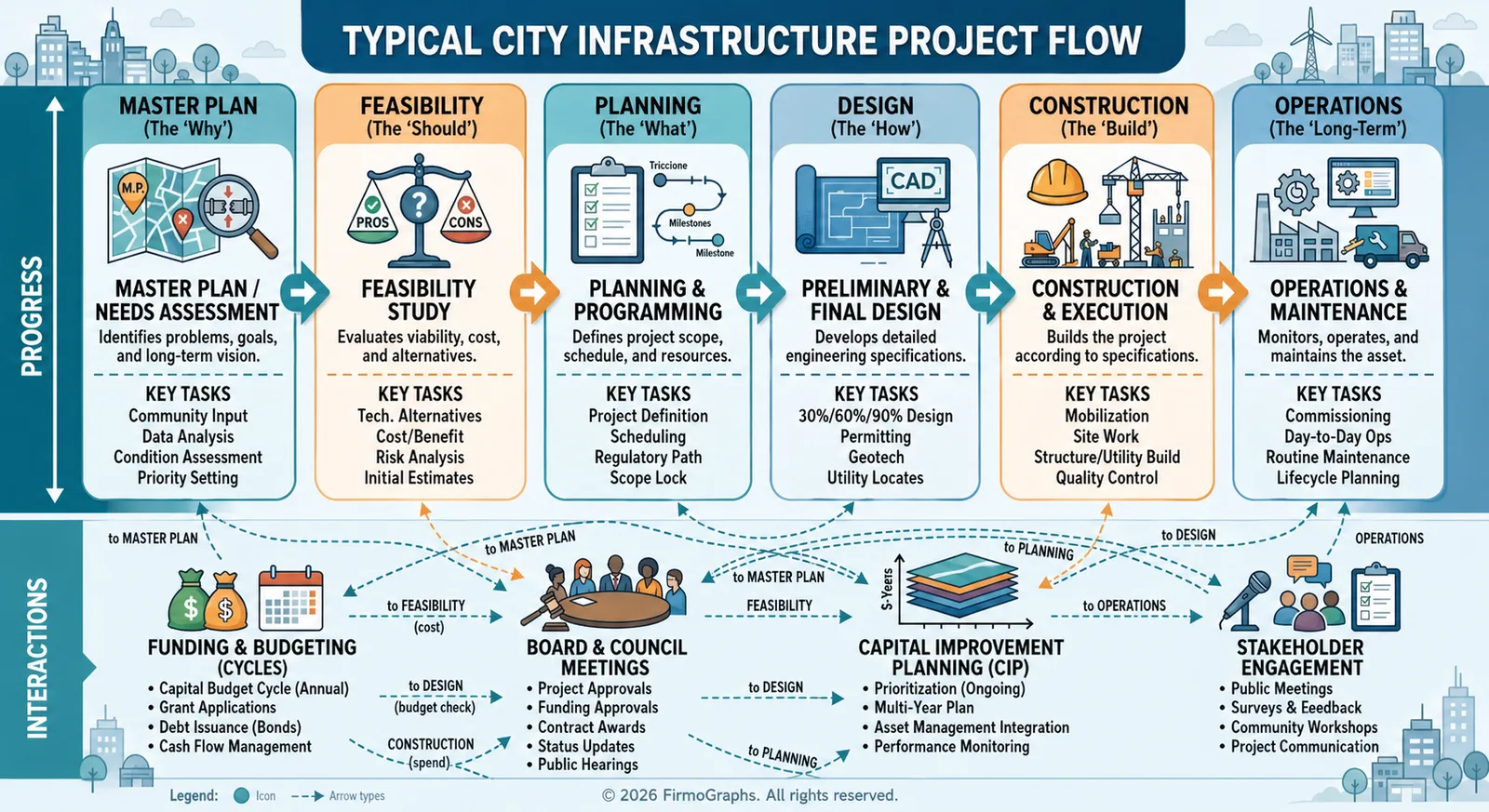
There is a peculiarity embedded in the way most firms pursue government infrastructure work: they enter the contest after it has effectively been decided. By the time a Request for Proposals lands on a bid portal, the agency has already spent months — sometimes years — scoping requirements, consulting informally with familiar vendors, and forming opinions about what a credible solution looks like. The formal solicitation, in this light, is less an open invitation than a ratification of conclusions already forming in the minds of procurement officers and department heads.
The consequences of this misalignment are measurable. Research tracking government contractors finds that 40 to 80% of government customers decide on their preferred vendor before a proposal is even submitted.[1] Firms that engage early, when specifications are still malleable and relationships still forming, operate in an entirely different market than those who arrive with a polished bid document on deadline day.
But early intelligence is not uniformly valuable. If a project is heading toward traditional Design-Bid-Build, early visibility offers only a modest edge: the specification will still be fixed, and competition will still converge on price and compliance. Where early knowledge changes the outcome is in Alternative Delivery — where relationships, technical credibility, and delivery strategy are formed before the market is formally opened.
Why Alternative Delivery Changes the Economics
Alternative delivery methods such as Design-Build, Construction Manager at Risk, and Progressive Design-Build matter because they move competitive advantage upstream. Firms are assessed earlier, on broader criteria, and with more emphasis on technical judgement, collaboration, and risk management than in traditional Design-Bid-Build procurement. In that setting, the decisive contest is not the bid itself but the period before it, when owners are still deciding whom they trust to help shape the project.
For firms competing in municipal infrastructure, that distinction is decisive. AEC firms, equipment providers, treatment technology companies, environmental service firms, waste operators, and other solution providers gain the most from early visibility when it helps them identify projects where the owner’s procurement path is still fluid. In those cases, being early is not just about showing up sooner. It is about entering the conversation while the delivery model, team structure, and technical framing are still taking shape.
What the 6-to-18-Month Window Actually Is
Municipal procurement does not begin with an RFP. It begins with a recognised need — a deteriorating water main, a treatment plant approaching the end of its useful life, a library renovation, a new police or fire station, a school modernisation programme, a parks improvement package, or a council resolution on solid waste infrastructure — that must travel through budget justification, capital planning, and internal approvals before it ever becomes a solicitation document.
This pre-solicitation phase typically surfaces during an agency’s annual budgeting cycle, often six to eighteen months before an RFP is formally issued. The government, at this stage, is as receptive as it will ever be to outside input — and for projects destined for alternative delivery, that receptivity is the window in which commercial outcomes are most often set.
What happens to vendors who are absent during this phase is instructive. They typically discover, upon reading a published solicitation, that the scope narrative has been shaped by conversations in which they had no part. In alternative delivery, this disadvantage is compounded: the owner has already formed views about which firms understand the problem, which approaches are viable, and which teams are worth the collaborative investment. Catching up after the solicitation is posted is rarely a winning strategy.
Where Does Pre-Bid Intelligence Live?
For AEC firms, treatment technology providers, equipment and infrastructure vendors, waste operators, environmental service firms, and solution providers alike, the strategic question is the same: how does one identify which agencies are entering this pre-solicitation phase — and whether the procurement is likely to take an alternative delivery path — before a formal notice appears?
The answer lies in a hierarchy of public documents that most vendors have never been trained to read as competitive intelligence.
Cities AI is most valuable not when it merely shows that a project exists, but when it helps firms distinguish which early projects are likely to become commercially actionable — especially when public records indicate that an owner is moving toward Alternative Delivery.
The discipline of monitoring these sources continuously — rather than reactively searching them when a project surfaces on a bid portal — is the difference between a firm that competes on terms it helped shape and one that competes on terms set by whoever arrived earlier.
Who to Engage: The Decision-Maker Landscape
Understanding when to engage is necessary but insufficient. The more consequential question is who to engage — and in what sequence.
Municipal infrastructure decisions involve multiple stakeholder roles operating simultaneously. There are users who will operate the system, influencers such as engineering advisors and department managers who shape the technical specification, deciders including senior executives and elected officials who authorise expenditure, and buyers in procurement departments who execute the contractual process. In alternative delivery procurements, the influencer layer carries disproportionate weight, because the criteria being set are qualitative and technical, not simply price-based.
In practice, the most productive early-stage relationships are with these technical influencers — department engineers, environmental programme managers, public works directors — who are engaged in scoping requirements and will have disproportionate influence over what the specification and delivery framework eventually become. A vendor that has established credibility with this layer before procurement formally opens has, in effect, acquired a reference inside the agency.
Effective pre-bid engagement is not a sales exercise masquerading as a courtesy call. It is a structured information exchange in which a vendor brings proprietary project case data, independent performance benchmarks, or deployment lessons from comparable systems — not a sales pitch dressed as a briefing — in return for a deeper understanding of the agency’s priorities, constraints, and timeline.
What Firms That Win Consistently Do Differently
The performance differential between firms that systematically pursue pre-solicitation engagement and those that do not is not marginal. Research on government contracting marketing metrics finds that firms operating with a formal capture process achieve win rates 15 to 25 percentage points higher than those without one. Customer relationship quality — tracked as a quantitative score across stakeholder engagement frequency and depth — emerges as a highly predictive variable for government contracting success.
The operational discipline this requires is modest compared to the cost of competing cold on a major government bid. AEC proposals on major projects cost 1 to 3% of the total contract value to prepare, and the average AEC team takes sixteen days to complete a single RFP response. In alternative delivery, where the response often requires a full team narrative, technical approach, and qualifications package, the cost of late entry is higher still. For chief growth officers and business development leaders, the implication is direct: a market intelligence capability that surfaces opportunities six to eighteen months before procurement — and identifies which of those opportunities are on an alternative delivery path — improves pipeline quality and reduces wasted pursuit effort.
Where Cities AI Fits
Cities AI is built around this earlier view of the market. It monitors publicly available records across municipal infrastructure owners in the United States — capital plan changes, budget authorisations, council activity, delivery method studies, permit filings, and funding signals — and structures them into project-level intelligence that firms can act on before the bid phase begins.
For a treatment technology firm, this means knowing which municipalities are approaching a compliance decision, treatment upgrade, or asset rehabilitation cycle before specification language has been set — and whether that project is being structured in a way that rewards early technical credibility. For a contractor or equipment provider, it means seeing where a capital programme is gaining financial and regulatory momentum across water systems, libraries, police and fire facilities, schools, civic buildings, and parks projects, and which of those opportunities are likely to move toward collaborative delivery rather than a conventional low-bid path. For an AEC or environmental service firm, it means identifying where relationship-building and technical insight will carry more weight than fee competition alone.
In long-cycle infrastructure markets, the firms that perform best are rarely those that simply respond fastest. They are the firms that understood the opportunity earlier, recognised when a project was becoming commercially actionable, and engaged while the market was still taking shape. Cities AI exists to make that earlier engagement systematic.
To see how Cities AI works, visit cities-ai.us.
References
[1] Nzhouat, “Marketing Metrics for Government Contractors: 2025 Research Report,” states that 40–80% of government customers decide their preferred vendor before proposal submission. Available at: source.
Frequently asked questions
- When does the pre-solicitation window open before an RFP?
- The pre-solicitation phase typically surfaces during an agency's annual budgeting cycle, often six to eighteen months before an RFP is formally issued — when the government is most receptive to outside input.
- Why does alternative delivery make early engagement more valuable?
- Alternative delivery methods such as Design-Build, Construction Manager at Risk, and Progressive Design-Build move competitive advantage upstream. Firms are assessed earlier on broader, qualitative and technical criteria rather than price, so relationships and technical credibility formed before the market opens carry decisive weight. In traditional Design-Bid-Build, by contrast, early visibility offers only a modest edge because the specification is fixed and competition converges on price and compliance.
- How much does a formal capture process improve win rates?
- Research on government contracting marketing metrics finds that firms operating with a formal capture process achieve win rates 15 to 25 percentage points higher than those without one.
- Who should firms engage first in the pre-solicitation phase?
- The most productive early-stage relationships are with technical influencers — department engineers, environmental programme managers, and public works directors — who scope requirements and shape what the specification and delivery framework eventually become, particularly in alternative delivery procurements where criteria are qualitative and technical.